Google

Tuesday, 16 May 2023

Three Little Pigs


The Three Little Pigs is the first in a series of Tales and Games from iello. With a recommended age of 7+ ,The Three Little Pigs looks like it is just a Children's game but after playing I found it scratches the dice gaming itch nice and quickly. Three Little Pigs sits 2 - 5 players and takes only 10-20 minutes to play even with the included Advanced Rules..


Objective:
Players roll dice and attempt to get enough of the same icons to construct a sections and eventually build a house solid enough to protect them from the Big Bad Wolf. Your goal in The Three Little Pigs is to have the house or houses worth the most points by the time three piles of building sections run out.

How to Play

On your turn you get to roll all 5 dice, 3 times. After each roll you are allowed to set aside any number of dice to keep or to stop rolling and use your results.

The icons determine which section you are allowed to take; Roof, Window or Door. The number of dice showing that icon determine which material that section is made out of; Straw, Wood, Brick. The building sections also shows 1 pig icon for each face up die result needed to purchase them.

You can only buy 1 section per turn and you do not have to use all of your dice.
Lastly houses without roofs are not worth any points.

Too easy? Here's the catch.

If at any point in time you roll 2 Wolf Icons then you must stop rolling and perform the Big Bad Wolf action.


Scoring

Scoring is pretty straight forward, even with the advanced rules so I will include them as well.

1 point for each pig icon displayed on your house sections.
1 point for each flower pot displayed on your house sections.

Advanced Rules:


My Thoughts:

With the advanced rules there is more than just a kids game here and we actually had a few games end really quickly because someone thought it was so easy that they forgot about the ending conditions and didnt have any roofs on their houses. Despite the simple rules and heavy influence of luck, The Three Little Pigs manages to stay fun when playing with both young children (4yr old) and adults. After our first few play throughs I thought 2 Wolf icons did not get rolled nearly enough but after playing more I realized this was just the luck we were having and 2 wolf icons show up just the right amount of times. My only criticism is that as you add more players you end up waiting longer for your turn and there is nothing to really keep you engaged other than if someone happens to roll wolfs. Playing The Three Little Pigs has gotten me excited to check out more of the Tales and Games series from iello and try them with my family.

Who Would Enjoy The Three Little Pigs?

Family Gamers: Adjustable rules that make the game harder or easier, easy to learn rules, and colourful dice help make The Three Little Pigs a great family game but really it is pretending to be the big bad wolf that kids are going to love.

Casual Gamers: If you do not own a dice game yet Three Little Pigs might be right for you. If you ever play with family, younger kids, or non gamers the theme might be appealing. I swear there is a golden drinking game hidden in here, will update once I have the rules straight. Since Three Little Pigs has virtually no setup time and takes only 10 - 20 minutes to play I think it fits nicely in a casual gamer's collections.


Saturday, 6 May 2023

Diamonsters


Diamonsters is a trick taking card game with Hand Management, Set Collection and Simultaneous Action Selection for 2-6 Players. Diamonsters is a light game that is played over multiple rounds and takes 15-20 minutes to play. The rules take only a couple minutes to learn so it makes an excellent warm up, introduction game, or family game. In my review I will quickly cover how to play and then dive into how the game scales and changes from 2-6 players. 
Diamonsters Card Game IDW Games


Setup:

Deal each player a set of 1 of each card. (1-5)


Shuffle the remaining cards, form a central draw pile, and turn the top card face up in the center of the table. 

Place the pile of blue diamonds next to the draw pile.

How to Play:

Every round lasts until a player collects monsters with a total of 5 Diamonds on their cards or 3 monsters of any kind. The first player to do so gets to take 1 blue Diamond. 


1. Each player selects a card from his or her hand that they are going to play but does not show what the card is.


2. Once all players have chosen, everyone reveals their card at the same time and you see who wins the card in the center of the table.


3. a) Any players who played the same card must return their card to their hand.
    b) The player with the highest value card remaining wins the face up card.
    c) All other players return their cards to their hands.
4. The winner takes the prize card and the card they used to win the prize and adds them both to their score pile. 


Winning the Game:

When a player has 3 of a kind or 5 diamond symbols showing on the cards in their scoring pile they win the round and gain a blue Diamond.

The first player to collect 3 blue Diamonds wins the game.


How does it scale?

2 Players - Sure you can play Diamonsters 2 player the same way you would with more players but I prefer to play differently. With just 1 opponent you can use deduction to try and figure out what card they are going to play. Pay attention to what card they usually try to win each monster with. For example, when a number 4 is the card up for grabs, you might try to win it with another 4 to already be on your way to scoring three of a kind. Because you both start with the exact same cards, I find there to be very little luck when playing Diamonsters with just 2 players and because the rules are simple, you end up playing your opponent more than the game.
3/4 Players: This is the sweet spot where Diamonsters works best. It's a good medium between the 2 player game and the 5/6 player game. With 3 or 4 players, Diamonsters becomes a little more luck based than with 2 because it's hard to play multiple opponents at once. The mechanics work great with 3 or 4 players and I usually manage to at least get 1 diamond. This is the format where Tiny number 1 was able to have the most success. 
5/6 Players - Expect a lot more taking your card back into your hand, which in my opinion is a bit of a bad design. There is a whole pile of cards available that you could draw a fresh one and looking at / using the exact same hand of cards repeatedly gets boring fast. That being said, it makes for a slightly different game play than with other number of players where you are pretty much trying to play the card that no one else does instead of the highest value card. Tiny was pretty useless because everyone usually assumed someone would play a 5 so they never did - or there would be multiple 5's that would cancel each other out and then you would have the lowest value card. This makes the game slightly more challenging than with 3/4 players albeit slightly frustrating. What is missing is the sense of accomplishment, it's disheartening having 0 Diamonds when someone else already wins the game. The beauty of Diamonsters with 5/6 players compared to other 5/6 player games is that because if the simultaneous action selection, it doesn't take any longer until it becomes your turn - which keeps you engaged even in a bigger group. Also, it does not really take any longer with more players. Hypothetically it could if every player got 2 Diamonds, but we never encountered that once, usually there is at least 1 player with 0. 


Friday, 28 April 2023

New Haven


New Haven is a City Building and Tile Placement game from R&R Games for 2-4 players. The gameplay is fairly simple but keeps you engaged even on opponents turns and is lots of fun. By the end of the game I am always left with a strong sense of accomplishment and a desire to play again. One of my favourite parts of New Haven is how you feel like you can always improve your game / score. Despite the simple rule set I have found New Haven surprisingly hard to teach to new players but once everyone has the game down it uses a great mix of both tactics and strategy. My group has really been enjoying New Haven and I cant wait to get into the review so please continue reading for how to play and my thoughts.


Objective:

Your objective in New Haven is to develop a settlement worth as many points as possible. Completing individual buildings are not worth any points, in order to score you will have to fill either entire columns or rows of your Land Plot with various buildings. There is a way to score double points on these rows or columns, but for the purpose of understanding the rules I will explain this at the very end when I cover final scoring.

How to Play:

On every turn a player will perform the following actions:

1. Place one of your tiles on the board
2. Collect the appropriate resources corresponding with the tile and where you placed it
3. Spend those resources on building tiles
4. Give other players a chance to use your left over resources
5. Place Building Tiles on Land Plot while other players are using your leftovers
6. After every player has had a chance at the leftover resources, replenish the available buildings and your resource tile


Tuesday, 4 April 2023

Beasty Bar


Beasty Bar is a Hand Management card game focusing on take that mechanics from Zoch Verlag (the company that brought us Ghost Blitz). Your objective is to get as many of your animals as you can through the lineup and inside a bar called Heaven's Gate. You will have to make sure that your animals do not get tossed from line and are actually allowed in, to do this you will manipulate the bar lineup. The only similar game I have played is Guillotine but even that is a stretch. In this review I will quickly cover how to play, how well it scales from 2-4 players and what kind of gamers I think would enjoy Beasty Bar.


Goal / Objective:

The goal in Beasty Bar is to have the most animals inside the bar Heaven's Gate when all players have no cards remaining in their hands.


How to Play:

Getting inside Heaven's Gate is not an easy task. First there have to be 5 animals in the lineup. Once the lineup is full the two animals in front (closest to Heaven's Gate) will be allowed inside the bar and the animal at the end of the line will be tossed into the get lost pile.

Thursday, 30 March 2023

Just Desserts

Just Desserts is a set collection and hand management card game from Looney Labs. 2 - 5 players can serve up Desserts and feel their stomachs grumble as they read the names of the cards. Similarly to other games from Looney Labs, Just Desserts has quick and easy to understand rules that let you jump right into actually playing the game. That also means that Just Desserts is a light card game that works best as a filler, intro or warmup game although there are some advanced rules that mix things up and make them more challenging.


Objective:

Your goal in Just Desserts is to satisfy the dessert cravings of various customers. To win you will need to serve:
3 customers of 1 suit
1 customer of 5 different suit.

How to Play:

At the start of every player's turn flip over the top card from the customer deck. If the customer is the same suit as one already in lineup, select which one you want to keep and discard the other. NOTE: The top customer card in the discard pile is still fair game, they are considered in the lobby and you can feed them desserts still.

Each turn you have the choice between feeding 1 or 2 customers, going back to the kitchen to get more dessert or dumping your tray.

Lets start with feeding customers.

Each customer has symbols on the top of their card. These represent their cravings. You can use any number of cards to satisfy a customer's cravings.You can even have extra icons as long as the customer is not allergic.

Select which customer you want to feed and play dessert cards until you have satisfied all of the customer's cravings, collect the customer card and add it to your personal score pile.

Each customer also has a favourite dessert written in small text below the symbols on their card. If you manage to serve a customer their favourite dessert then you get to collect the customer card and a  tip! (bonus dessert card from the dessert deck)


Going back to the Kitchen simply means you get to draw a card from the dessert deck.

Dumping your Tray lets you choose how many cards from your hand to discard and then draw that many cards from the dessert deck.


My Thoughts:

Just Desserts fits nicely in my collection. The main draw for me is the accessibility. Desserts bridge the generation, race and age gaps, I mean who doesn't love Pineapple Upsidedown Cake? With 5 players you can finish a game in 30-40 minutes and turns go around the table fast. Combine these with easy to learn rules and that means you can show Just Desserts to pretty much anybody. That is exactly what I have been doing, playing Just Desserts with my non gamer friends, family and whatever other creatures I can convince to play. The 2 player game is great because it can be played in 10-15 minutes and you get some take that action if you use the advance rule: Poaching and Blocking.

My only real criticism lies in the customer card design. In a game centered around Desserts it seems only right that the customer's favourite dessert would be in big easy to read letters and their name would be in the small text. Especially when their names do nothing mechanically but their faovurite dessert does, sadly this is not the case and the favourite desserts appear in the smallest text on the card. Just Desserts can also overstay its welcome, not as long or often as Munchkin or Fluxx but it can drag occasionally at higher player counts (4,5).

The advanced rules really add to the basic rules to make a pretty ruthless set collection game. I will explain them each below so you can read for yourself.

Poaching and Blocking: Allows you to steal a guest from another player by serving them just like you would a guest in the center but only 1 per turn, You can still serve a second customers from the middle after. Blocking comes into play when someone tries to steal one of your customers, you can play dessert cards to match their craving symbols the same way you collected the customer in the first place to stop the theft from taking place. If blocked, you get to keep your dessert cards and you can still take 2 guests from the center but may not poach again until next turn.

Opening a Buffet: This extra rule adds another action you can choose to perform on your turn. If you have 4 single flavor desserts you can discard them all to force every other player to put one of their customers back in the middle, draw 3 more dessert cards and then serve 1 guest.

Surprise Party: When someone serves a customer either from the middle or when stealing from another player you can intercept the customer by throwing them a surprise party. You have to shout surprise, and you have to have the customer's favourite dessert. If the customer has 2 favourites you cannot surprise party a favourite and you can only block a favourite with another favourite. Lastly you do not get a tip for throwing a surprise party.

Family Gamers: You can easily take Just Desserts to family get togethers or vacations because it is essentially 2 decks of cards. There is also the Family friendly theme, rules that are easy to learn for younger and older players and practically no setup or cleanup time. Oh and when you master the game or get bored you can throw in the advanced rules 1 at a time.

Casual Gamers: This is a great game for playing with non gamers or trying to introduce people to the hobby with. You learn key mechanics (hand management, set collection, icons?) that will help learn other games. The theme might be a plus or a con depending on who you are playing with but I have had no problem getting friends and family to try. Being able to add additional rules is a big plus and at only 15$ Just Desserts is a great buy.

Gamer Gamers: The advanced rules bring different take that mechanics into the game that let you steal your opponents customers. Because you only need 3 of a customer suit this means the game can change much quicker and in my experience eliminated the problem of Just Desserts overstaying its welcome. Adding the advanced rules make it so you have to pay attention to what you opponents are doing, the number of cards in their hand, etc. There is more going on with the advanced rules, so there is more to keep you engaged. Its not a brain buster but there is a pretty intense card game hidden beneath the cheery dessert theme that makes it a great option if you are looking for a short, fast, easy to learn game.


Friday, 24 February 2023

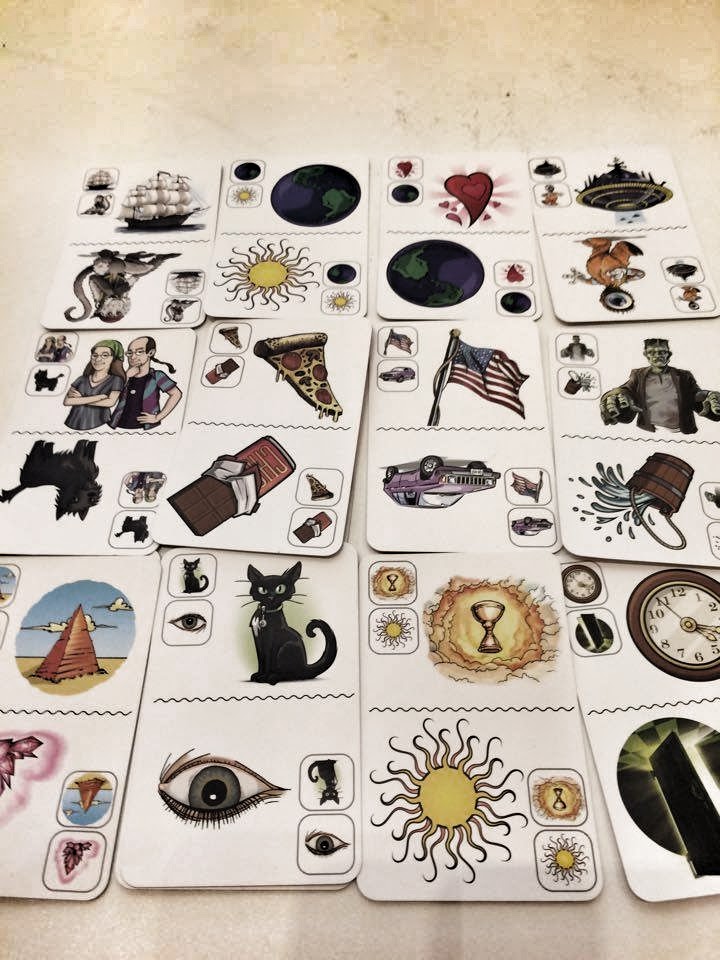
Loonacy: the maniacal matching card game


Loonacy is a fantastic, real time card game for 2-5 players from Looney Labs. There is absolutely 0 text and you can learn the rules in roughly 15 seconds. Even though it is just a short game, playing is highly addictive. On our first night playing Loonacy it ended up being our only game in play. Since then, it has become one of the greatest intro and filler games in my collection. Because learning how to play is really simple, I will focus on why I think Loonacy makes an exceptional intro game, how well it scales between 2-5 players, and who I think would enjoy the game.


How to Play:

Playing is very simple. The goal of the game is to be the first player to discard all cards from your hand. In order to discard a card from your hand, you must match one of the two symbols on it to one of the two symbols on the top cards of one of the various discard piles.

It seems simple, but now for the catch: there are no turns. Like I said at the top, this is a real time card game. This means everyone is going to play at the same time and the top card of the discard piles can change at any moment. Loonacy will test your reflexes and ability to recognize patterns at a glance as you race to rid yourself of your hand of cards.

That if you cannot play a card? You simply wait for the top card of the discard piles to change and hope a symbol you can match with comes up. If you find yourselves suddenly staring at each other with no one able to take a turn, everyone must then draw a card. Make sure to keep the new cards face down until everyone has their new card; that way no one has an unfair advantage. 

Setup:

Shuffle the cards into 1 draw pile.

Turn over the top cards of the draw pile, creating a number of separate discard piles depending on the number of players.

5 Player Setup: Loonacy


4 Player Setup: Loonacy


2 Player Setup: Loonacy


3 Player Setup: Loonacy


Deal each player a hand of 7 cards, players should not look at their cards until everyone is ready to start playing.

Why is Loonacy an awesome intro game?

The board game scene has seen an influx of new gamers and general peaked interest in the past few years. Even so, when I try to introduce someone to the hobby or it comes up that I play board games, I am still often met with, 'What, like Monopoly?' Rather than try to explain what modern gaming consists of, with Loonacy you can say, 'It's easier if I show you and it will only take 4 minutes'.

Obviously you won't always have the opportunity to bust out Loonacy and show someone, but the combination of how fast it plays and how quick it is to explain are part of what makes it an awesome introduction game. Other than eliminating time constraints, this demonstrates that newer games don't always take as long as Monopoly or Risk. And if someone is upset by losing, Loonacy is fast enough that you can just play again.

Examples of Cards: Loonacy
Loonacy has several other appealing intro features besides just being a quick play game. For example, there is no benefit to the person teaching so no one will feel as if you have an unfair advantage. Players will get used to matching various icons and quickly assessing/managing their hand of cards.

Another part of an intro game is the desire to play again. This is often coupled with a sense of accomplishment and desire to do better the next time you play. Loonacy almost always leaves me wanting to play again, especially when it was a close game and I only had a card or two left.

Who would enjoy Loonacy?

Although I would love to say Loonacy is for everyone, it clearly is not. If you do not like speed/reaction games, this is a definite no - even though it is easier and quicker than some of the other similar games I have played. My second disclaimer: if you are not a fan of the standard randomness that comes with Looney Labs games, I would avoid picking up Loonacy. Let us now turn your attention to those who will enjoy Loonacy:

New Gamers: With a low price and small box, it is easy to add to your collection. It is also a fairly unique game and even if you own another reaction game, it is worth picking up this game specifically. It is easy to get your friends to play because there are no cumbersome rules and I always have an easier time getting non-gamers to try a card game than I do a game with a board and pieces. Lastly, a benefit to playing this game is that it gets you used to icon matching and hand management which are big parts of a lot of other games in the hobby, regardless of their complexity.

Casual Gamers: When you do not get to play board games every night or get to play with the same group of people and enjoy lengthy session, two of the most important things to me are setup time and explanation time. Loonacy takes longer to shuffle than it does to setup and explain. Another important aspect of casual games to me is how often they actually get played, since a casual board game budget might not support as many games. I have more than a couple light, filler games, but Loonacy has managed to dethrone them all and shows no signs of becoming a dust collector anytime soon. It's also physically light and small so you can easily bring it with you.

Gamer Gamers: You can never have enough games to introduce to new gamers and Loonacy does a great job filling this role. It can also help you even out your collection, as I think speed/reaction games are underrepresented in a lot of bigger collections. At the very least, Loonacy is a fast filler than you can play while waiting for other players to arrive or wrap up any games that they are already playing. 

How it Scales 2-5 Players

2 Players: The gameplay is fun but gets old a lot quicker with just 2 players. I find you end up drawing a lot more cards which slows down the pace of the game. It seems weird that with 4 discard pile options you would have to draw a card but for some reason with 4 options there always seem to be multiple piles with the same icon on top. Lastly I find 2 player Loonacy to just be less exciting, there is no shouting, cheering, fighting over who is putting their card down first. That does not mean I dislike 2 player Loonacy, it has its place like on a hike, hanging by the pool or when you are desperate to squeeze in even a couple minutes of gaming.

3 Players: The three player setup has my preferred number of discard piles. I find that they all change often enough to keep the pace of the game quick and give you lots of options. Occasionally two discard piles will have the same icon on top but not as often as in the 2 player setup. When we play with any number of players now we almost always use the 3 discard pile setup because it seems to work the best to keep the game flowing. We never timed any of our games but I feel like 3 player games were over the quickest.
 4 Players: The setup says to only use 2 discard piles which creates a more intense game than with 2 and 3 players. There is much more competition for the discard piles meaning if feels like someone is almost always going for the same icon as you. I found that with only 2 discard piles we ran into a lot more cases where everyone had to draw a card. Using the 2 pile setup and playing with 4 players felt like games would either be over really fast or really slow, this is why we now use 3 piles instead of 2.

 5 Players: After reading my opinion on 4 players I am sure you can guess how I feel about 5 players all using 1 discard pile. The discard pile is a revolving door of icons and the game can finish before you even play a single card. Or you can get down to 1 or 2 cards and suddenly be back at 7 or 8. I don't think you have to draw cards as often as with 4 players because the icons are changing so often but sometimes you get stuck drawing 3 or 4 cards in a row because no one can make a match. 5 players is my favourite way to play Loonacy, I like the chaos, excitement and volume of playing with 5 players but disliked the 1 discard pile setup. We normally use 3 discard piles but still change it up and play around with different setups and I would definitely suggest doing the same. 

Tuesday, 17 January 2023

Magic Labyrinth


Magic Labyrinth is a great game for kids and families to play together. In my review of Magic Labyrinth I will take a slightly different approach from normal. I will cover the rules and how to play from two different angles. The first and most obvious is Magic Labyrinth as a kids/family game but we recently discovered how it makes a fantastic drinking game.


Friday, 25 July 2014

Online Game Review - Stone Age


This is my first attempt at reviewing an online board game. I see a lot of people wondering where they can play board games online and I think there is a lot to be gained out of the experience. But this is not a post to try and convince you to get your gaming fix online, instead I am going to review Stone Age on BoardGameArena and talk about the pros and cons to playing Stone Age online vs in person.


Wednesday, 9 July 2014

Guide to Teaching Board Games - Streamlined Explanation - Rialto

| April 4th 2016 | 
Thanks for checking out my blog. I have a new, much better looking version of this review here: http://www.boardgamebarker.com/blog/2015/12/21/guide-to-teaching-board-games-streamlined-explanation-rialto?

This is part two in a in a series I am writing to help people become better board game teachers in the hope that we can scare less people off and change the attitude that the games we play are "way too complex and have so much to remember". Below I will cover how to explain Rialto, a medium weight Area Control Game by Stefan Feld, in an easy to follow manner covering only the need to know information.


You can find the first part by taking this link where I explain my five steps to explaining any board game in detail. Guide to Teaching Board Games = The Five Steps


Wednesday, 18 June 2014

Ghost Blitz 2.0


Ghost Blitz 2 Reviewed by Todd Barker on : Ghost Blitz 2 is a dexterity and shape recognition card game for 2-8 players ages 8 and up. In my review I will explain why it is not just a kids game and show Ghost Blitz 2 is played

Being a fan of the original Ghost Blitz it was only a matter of time before I added the second to my collection, why bother you might ask. Well the answer is quite simple, with 5 new pieces and another deck of cards you can add both games together to support more players or if you simply want a more challenging game. Of course Ghost Blitz 2 can also be played on its own and is just as exciting as the classic Ghost Blitz.
Ghost Blitz 2 by Zoch Verlag  - Board Game Box


Monday, 9 June 2014

Templar The Secret Treasure


Templar Reviewed by Todd Barker on : Templar: The Secret Treasure is a area control and role selection board game for 2-5 players from Queen Games. In my review I will cover how to play Templar, how well it scales up to 5 players and who I think should buy the boardgame.


Friday, 23 May 2014

Guide to Teaching Board Games - Five Steps

| April 4th 2016 | 
Thanks for checking out my blog. I have a new, much better looking version of this review here: http://www.boardgamebarker.com/blog/2015/12/21/guide-to-teaching-board-games-five-steps

You're holding it in your hands, that awesome cool looking game that you really want. What's holding you back? Maybe your group just isn't in to those type of games, maybe your group doesn't have enough players, or maybe you just suck at explaining how to play.

This is the first part in a series that will hopefully help you become a better board game teacher so that you can not only play any game with your friends / gaming group but you will also have no problem at all introducing new people to the wonderful world of board gaming.

Before diving into what you can do to make sure you are explaining the game to the best of your ability I will first cover the biggest mistake you can make.

Avoid long winded explanations: This is by far the biggest point, I have seen many explanations lose players entirely this way. So much wasted time when you go through a 25 minute explanation only to have players ask what to do or how this works or what that thingy is. Do not explain every little detail there is, keep things short and sweet. I will talk about this more below but for context it is important to understand that trying to explain too much at once, or in the wrong order, adding little irrelevant details will overload the people you are wanting to teach your game to. Instead you should keep them on a need to know basis.


Wednesday, 21 May 2014

Machi Koro


Machi Koro Reviewed by Todd Barker on : Machi Koro is the next great boardgame craze coming out of Japan. A fast paced and light engine building card game for you and up to 3 friends.

You might have seen this game come up recently online, a lot of people are predicting it to be the next big craze and I will do my best to explain why. In my review of Machi Koro I will explain how to play as well as how I liked it with 2/3/4 players. I also consider the who should buy section much more important than usual and of course I will touch on my thoughts including why I think Machi Koro is a great replacement for monopoly and why I think some groups might ditch it unfairly.

machi koro box card game japanese art

Monday, 12 May 2014

Online Board Gaming Pros and Cons

| April 4th 2016 | 
Thanks for checking out my blog. I have a new, much better looking version of this review here: http://www.boardgamebarker.com/blog/2015/12/28/online-board-gaming-pros-and-cons

Often when I see "Online Board Games" brought up they are talked about as if they are inferior to playing their physical counterparts. I am going to try and highlight some of the pros and cons I have noticed while gaming online. Personally I do not feel that one way of playing is superior to another I think it is entirely situational and dependent on what mood you are in and how much time/money/friends are at your disposal.

Thursday, 1 May 2014

Fairy Tale


Fairy Tale is a card drafting game that plays very quickly and seats 2-5 players. I don't have a lot of experience with drafting games but out of the ones I have played this is one of my favourites. Fairy Tale has been knocking all our other filler games off the table since we picked it up. What I like best about it compared to other drafting games other than the play / setup time is how the gameplay encourages you to draft to hinder your opponents. Read below for a quick explanation of how to play and my thoughts on how it scales between 2 and 5 players.


Thursday, 10 April 2014

Smash Up


Smash Up is perhaps one of the most misunderstood board games I have had the opportunity to play lately. I picked it up about a month ago based off a recommendation in /r/boardgames, it was pointed out to me that Smash Up is by the same designer as Guillotine which has become our go to filler for quite some time. Even after doing some research and discovering they had little to nothing in common, I was sold by the artwork/theme and stopped by my flgs to grab a copy of Smash Up the next day.


Tuesday, 18 March 2014

Rialto


Rialto is a medium area control game by the well known board game designer Stefan Feld. Although I have wanted to try one of his games for a while this is my first run in with one of his titles. I really enjoyed it, there are multiple layers to the gameplay and you have tons of options when you develop your strategy, yet it still is over quickly as long as no one playing is AP prone.

Thursday, 6 March 2014

Alien Frontiers: Factions


Alien Frontiers has long been one of my favourite 3 player games, its alright with 4 I just have a few other games I would rather play. Playing Alien Frontiers requires a great balance of tactics and strategy, you will need to plan a few turns ahead but not really be concerned about the order or timing of your plans. Of course, Alien Frontiers gives you the opportunity to screw your friends over and over. Even though my group tends to avoid conflict, we seem to all enjoy blocking each other from expanding our space colonies. The Factions expansion makes the 4 player game considerably more enjoyable as well as adding a 5th player, keep reading for more information and my thoughts on if it is worth buying or not.

To read my review of the base game click here:

Thursday, 27 February 2014

Guillotine


What could be more exciting than harvesting the heads of nobles and scoring points for pleasing the crowd. Not much, Guillotine is a fast paced card game where 2-5 players take on the role of executioners and must compete to collect the most valuable heads. The game is played over 3 rounds, below I will walk you through 1 of these rounds as well as give my thoughts on Guillotine as a filler and as a 2 player game.

Monday, 3 February 2014

Alhambra


Recently my regular group of 3-4 has been 5 or even 6, as so some of my favourite games have not seen a lot of action of late. Instead we have been playing a lot of games that support 6, my issue is that most of them are too light. So I decided to bust out Alhambra since even if it is just as light it feels like you are accomplishing more to me. Below you will learn how to play basic Alhambra, and since I now have more experience with more players I will spell out my feelings on how well it scales with 2-6 players.